By Dr. Caroline Fiddler | Doctor, IVF Patient, Co-founder of CycleGuide
I still remember the night I realised I had taken my morning medication twice. I sat on the bathroom floor holding the packet, going over everything in my head, trying to work out how it happened. I had read the instructions. I had set alarms. I was being so careful.
And yet.
If you have done something similar during your cycle, I want you to know something before we go any further: you are not careless. You are not failing. You are a person carrying an enormous amount, trying to manage a medical protocol that most healthcare systems hand over with a printed sheet and a wave goodbye.
That is the real problem. Not you.
What you are actually being asked to do
A standard IVF stimulation cycle involves somewhere between four and eight different medications. Each one has its own dose, its own timing, its own way of being given, and its own storage needs. Some go in the fridge. Some do not. Some need to be taken at a specific hour. Some need to be given within a window. Some you take until you are told to stop, and some stop on a date that then changes when your scan results come back differently than expected.
And all of this shifts as the cycle progresses. What you were told on Day 1 is not always what you are doing by Day 8.
I say this not to overwhelm you but because I think patients deserve to hear it plainly. This is not a simple routine. It is a complex, changing medical protocol, and you are managing it largely on your own, at home, while the rest of your life keeps going.
Why mistakes happen to careful people
When your brain is under sustained stress, your working memory shrinks. This is not a character flaw. It is basic neuroscience. And IVF is, by its nature, a stressful experience. The emotional weight alone is significant. Add in the physical side effects of the medications, poor sleep, the anxiety before every scan, and the financial pressure that sits underneath all of it, and you have a person who is already running at capacity before they even look at their medication schedule.
Research consistently finds that adherence to medication gets harder as the number of medications increases, and harder still when treatment is linked to high emotional stakes.[3] IVF ticks both boxes. One study of 556 women undergoing fertility treatment found that only 30.4% had high medication adherence during their cycle — not because they were not trying, but because the regimens are genuinely complex.[2]
The mistakes are not coming from carelessness. They are coming from a system that was not designed with the full picture of your life in mind.
The mistakes I see most often
These are not dramatic errors. They are quiet, understandable slips — the kind that research into patient experience in fertility care has documented repeatedly.[1]
•
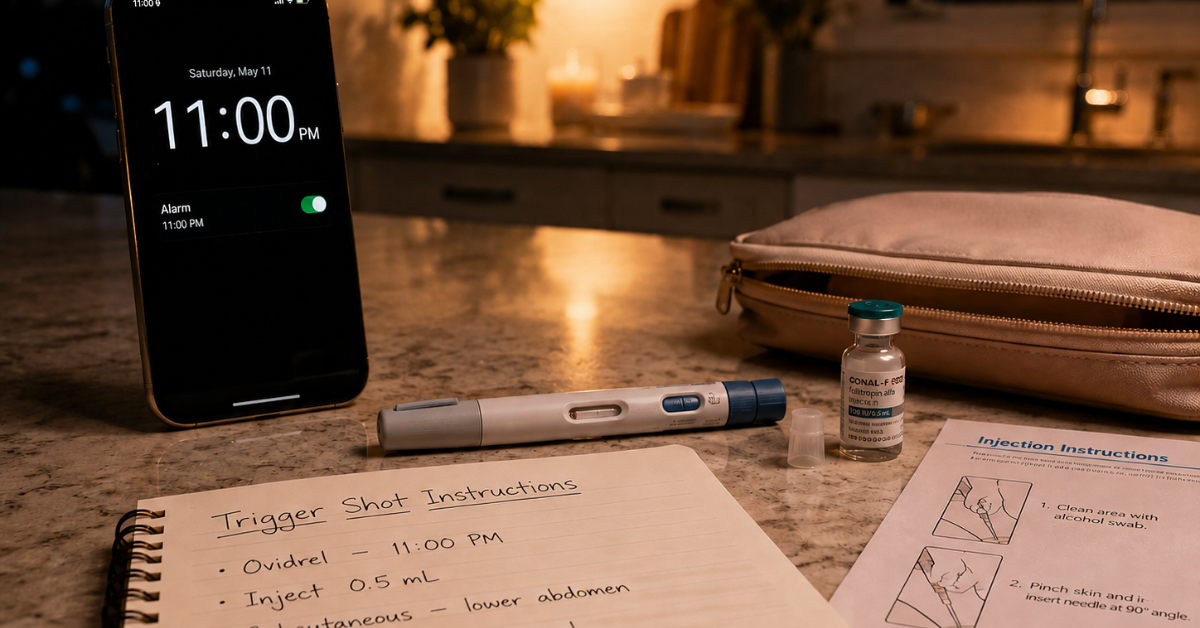
Taking the trigger shot at the wrong time. Even an hour can matter here, because the trigger shot is what times egg retrieval. It happens because patients are often told “around 10pm” without enough context for why the exact time matters.
•
Missing a progesterone dose. Usually in the evening, usually when you are exhausted, usually after a day where everything felt like a lot. The reminder did not go off, or it did and you forgot you snoozed it.
•
Leaving injectable medications on the bench overnight. Gonadotrophins like Gonal-F are temperature sensitive and must be stored in the fridge. They are usually given at night, which means they often stay out longer than they should. It only takes one night of forgetting.
•
Stopping a medication too early because you assumed the cycle was finished. This tends to happen post-retrieval, when patients feel like the active phase is over. Progesterone support typically continues well into early pregnancy if the cycle works.
•
Doubling a dose accidentally when a new prescription arrives. You are not sure if it replaces what you had or adds to it, and the instructions do not make it clear.
Each one is easy to understand. Each one tends to arrive with a wave of guilt. That guilt is almost always disproportionate to what actually happened.
What actually helps
A few things that make a genuine difference, in my experience as both a doctor and a patient.
•
Rewrite your protocol by day, not by medication. Instead of a list of drugs with their doses, map out what each day actually looks like. Day 3: take this, take that, inject this. Day 4: same, plus this new one starts. Your brain tracks time, not drug names.
•
Stop relying on memory. Use something outside your head. A whiteboard, a printed checklist you cross off each day, an app that shows today’s tasks and nothing else. Your brain is already working hard enough.
•
Ask your nurse to confirm storage for every medication, in writing. This is not a silly question. Many patients are not told which medications are temperature sensitive and find out the hard way.
•
If you miss a dose, call before you do anything else. Do not guess. Do not double up to compensate. Most clinics have a protocol for exactly this situation. Nurses would rather take a call at an inconvenient time than manage a complication from a well-intentioned but wrong decision.
Why I built something for this
Part of the reason CycleGuide exists is this exact problem. Not because patients cannot handle the information, but because they should not have to hold an evolving medical protocol entirely in their own heads, on top of everything else they are already managing.
A clear, day-by-day view of what to take, when, and how, sent directly from your clinic, removes a layer of pressure that should not have been there in the first place.
You are doing better than you think
If you have made a mistake during your cycle, or are terrified you will, I want to leave you with this: the patients who worry most about getting things right are almost always the ones who are paying the closest attention.
The goal is not a perfect record. The goal is a system that catches things before they become a problem. Build that system early, ask for help when something is unclear, and try to extend yourself the same patience you would offer anyone else going through this.
You do not have to carry all of this alone.
References
1. Dancet EAF, Van Empel IWH, Rober P, et al. Patient-centred infertility care: a qualitative study to listen to the patient’s voice. Human Reproduction. 2011;26(4):827-833. doi:10.1093/humrep/der022
2. Ni Y, Tong C, Xu L, et al. Prevalence and associated factors of medication adherence among infertile women undergoing frozen-thawed embryo transfer cycle: A cross-sectional study. Frontiers in Pharmacology. 2023. doi:10.3389/fphar.2023.1148867
3. Haskard Zolnierek KB, DiMatteo MR. Physician communication and patient adherence to treatment: a meta-analysis. Medical Care. 2009;47(8):826-834. doi:10.1097/MLR.0b013e31819a5acc