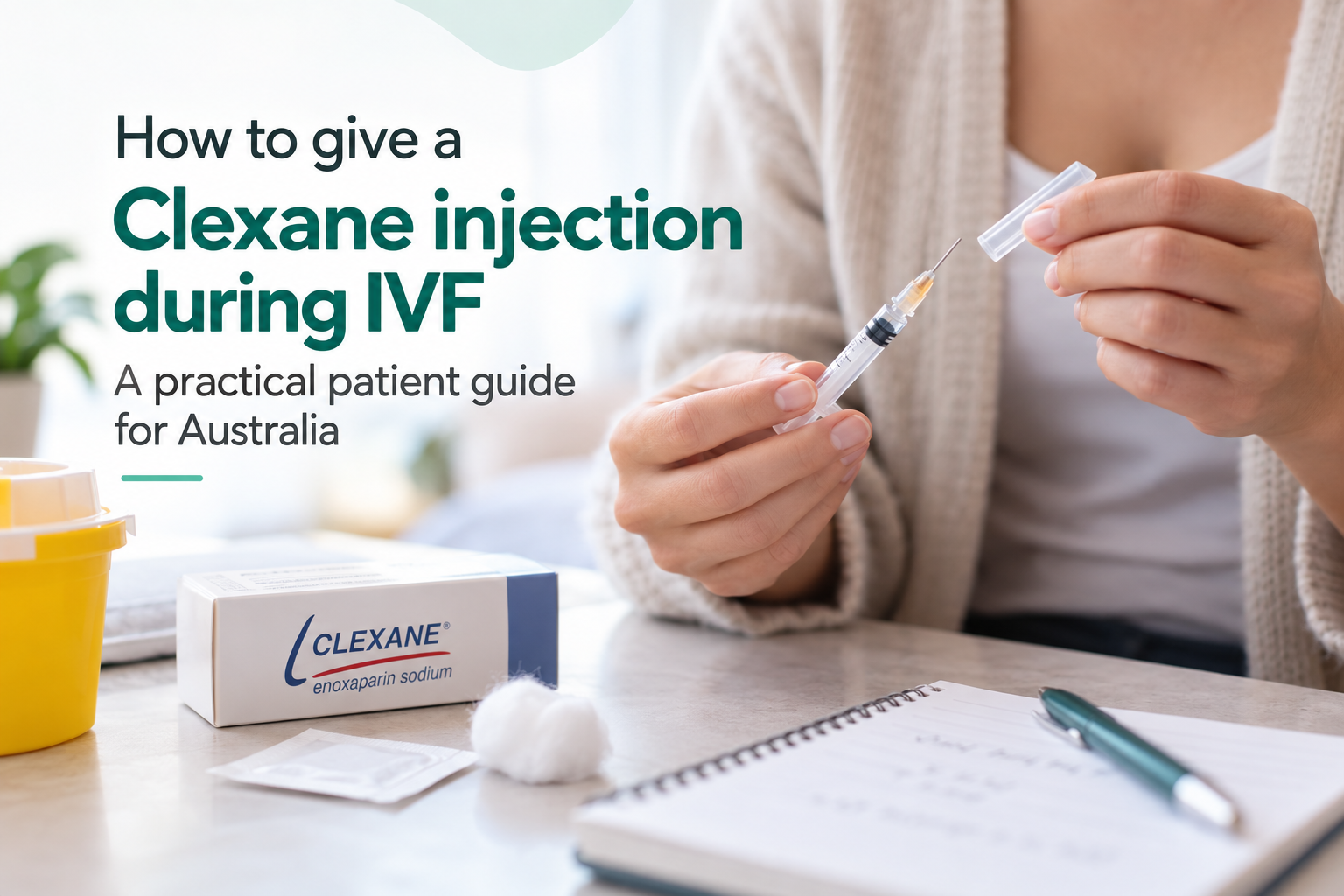
If Clexane has been added to your fertility treatment plan, you may suddenly find yourself holding another syringe and thinking:
“Right. How exactly am I supposed to do this?”
Clexane contains enoxaparin sodium, a low-molecular-weight heparin, or LMWH. It is an anticoagulant medicine used to help prevent and treat blood clots.1
Clexane is available in Australia in registered prefilled syringe presentations, including newer products with an automatic safety-lock system.2
But before getting into the practical side of injections, there is one important distinction.
Clexane is not a routine IVF medication for every patient.
Why it has been prescribed matters. Your fertility specialist or other prescribing doctor should explain the reason, dose, timing and duration that apply to you.
This guide is not intended to decide whether you should use Clexane. It explains practical points for Australian patients who have already been prescribed enoxaparin by their healthcare professional.
What is Clexane?
Clexane is a brand of enoxaparin sodium. It belongs to a group of anticoagulant medicines called low-molecular-weight heparins.
The Australian Consumer Medicine Information explains that Clexane helps prevent existing blood clots from getting bigger and helps prevent new blood clots from forming.1
Clexane is generally administered by subcutaneous injection, meaning the medicine is injected into the fatty tissue beneath the skin.
Your dose and treatment schedule depend on why the medicine has been prescribed and your individual clinical circumstances.
Why might Clexane be prescribed during fertility treatment?
There is no single reason that applies to every IVF patient.
Some patients may have a separate medical indication for anticoagulation. Low-molecular-weight heparin has also been investigated in fertility care, including recurrent implantation failure and patients with particular clotting conditions.
That does not mean Clexane has been shown to improve IVF success when routinely given to everyone.
The 2023 ESHRE good-practice recommendations state that low-molecular-weight heparin is not recommended to increase the chance of pregnancy or live birth in women with recurrent implantation failure.3
If Clexane appears on your treatment plan, one of the most useful questions you can ask your fertility specialist is: “What is the medical reason you are prescribing Clexane for me?”
Before giving yourself a Clexane injection
If this is your first dose, your fertility clinic, doctor, nurse or pharmacist should show you how to use the specific syringe you have been supplied.
Before injecting, check:
- the medicine was prescribed specifically for you
- the strength and dose match your current treatment instructions
- you know when the dose is due
- the syringe is not damaged
- the medicine has not expired
- you understand how your particular syringe works
- you have an appropriate sharps container available
If something does not look right, stop and check.
If the dose, syringe or timing differs from what you expected, contact your fertility clinic, prescribing doctor or pharmacist before injecting. Do not guess.
How to administer Clexane at home
The most important instruction is to follow the technique demonstrated by your healthcare professional and the current Consumer Medicine Information supplied with your specific Clexane product.1
Australian Clexane syringes are available in different strengths and presentations, including products with automatic safety-lock systems.2 Device-specific instructions therefore matter.
1. Wash your hands
Wash and dry your hands before handling the syringe.
Choose somewhere comfortable, clean and well lit where you can clearly see what you are doing.
2. Check the medication and dose
Compare the medication label with your current prescription or fertility treatment plan.
Do not change your dose because another patient has been prescribed something different. Their medical indication may not be the same as yours.
3. Follow the instructions for your specific syringe
Different Clexane presentations may use different safety mechanisms.
Use the instructions supplied with your medicine and the technique demonstrated by your doctor, nurse or pharmacist rather than assuming that every online injection demonstration applies to your syringe.
4. Use the injection area recommended by your healthcare professional
Clexane is administered under the skin.
Your healthcare professional should tell you where to inject and which areas to avoid.
Do not improvise if you are uncertain about the injection site. Contact your clinic or pharmacist for clarification.
5. Give the injection exactly as you were shown
Your fertility nurse, doctor or pharmacist should demonstrate how to hold the syringe, prepare the skin, administer the prescribed dose and operate any safety mechanism associated with your particular syringe.
If you cannot remember the technique once you are home, contact them rather than guessing.
6. Follow your prescribed schedule
Your clinical team should tell you when treatment starts, how often you should use Clexane and when it should stop.
Do not change or stop anticoagulant treatment without discussing it with the healthcare professional responsible for your care.
7. Dispose of the syringe safely
Used syringes should be placed in an appropriate sharps container.
Ask your fertility clinic, GP or pharmacist about local sharps-disposal arrangements in your Australian state or territory.
What about the air bubble in a Clexane syringe?
This is a common source of uncertainty when people first start using prefilled anticoagulant syringes.
Rather than applying instructions from another brand or an overseas product, use the current Australian Consumer Medicine Information supplied with your specific syringe and follow the technique your pharmacist or fertility clinic has demonstrated.1
If you are unsure what to do with an air bubble, do not make the decision from a social media post, forum or unrelated injection video. Ask your pharmacist, fertility nurse or prescribing doctor before administering the dose.
Is bruising normal after Clexane?
Bruising can occur with low-molecular-weight heparin injections.
ESHRE’s review of LMWH in fertility treatment notes that LMWH generally has a favourable safety profile in pregnancy but can cause bruising and bleeding.3
Because Clexane is an anticoagulant, however, you should not automatically assume that every episode of bleeding or bruising is insignificant.
Contact your doctor or fertility clinic if you are concerned about:
- bleeding that seems unusual or excessive
- large or worsening bruises
- persistent bleeding from an injection site
- blood where you would not normally expect it
- any new symptom that concerns you
For significant or uncontrolled bleeding or another medical emergency, seek urgent medical attention.
What if I miss a dose?
There is no appropriate one-size-fits-all IVF instruction for a missed dose of Clexane.
What you should do may depend on why Clexane was prescribed, your prescribed dose, when the dose was due, other medicines you take and where you are in your treatment.
Contact your fertility clinic, prescribing doctor or pharmacist for individual instructions. Do not take an additional dose simply to compensate unless your treating healthcare professional tells you to.
The same principle applies if your fertility treatment plan changes. Check how the change affects your Clexane schedule with the clinician responsible for prescribing it.
What if I accidentally use too much?
If you believe you have administered more Clexane than prescribed, seek medical advice promptly.
In Australia
For advice about a possible medication overdose, contact the Poisons Information Centre on 13 11 26.
For severe bleeding, collapse, difficulty breathing or another medical emergency, call 000.
What about aspirin, ibuprofen and other medicines?
Anticoagulants can interact with other medicines or increase bleeding risk when certain medicines are used together.
This does not mean that medicines such as aspirin can never be prescribed alongside Clexane. In some clinical situations, healthcare professionals intentionally prescribe combinations of medicines.
Make sure your fertility specialist, prescribing doctor and pharmacist know about everything you are taking, including:
- prescription medicines
- over-the-counter medicines
- aspirin
- anti-inflammatory medicines
- vitamins
- herbal products
- supplements
Do not independently start, stop or change another medicine because of something you have read online. Check with your treating healthcare professional.
Does Clexane improve IVF success?
This needs a careful answer.
Clexane should not be viewed as a routine treatment that improves IVF success for everyone.
The 2023 ESHRE good-practice recommendations reviewed LMWH in recurrent implantation failure. The evidence reviewed did not demonstrate a clear improvement in live birth or clinical pregnancy, and ESHRE states that LMWH is not recommended to increase the chance of pregnancy or live birth in women with recurrent implantation failure.3
That does not mean anticoagulation has no place in fertility or pregnancy care. It means that treatment should have an appropriate medical indication for the individual patient.
If you do not understand why Clexane has been prescribed, ask your fertility specialist or prescribing doctor to explain the indication in your case.
The IVF part that is not written on the medication box
The injection itself may be brief.
Remembering everything around treatment can be another matter entirely.
Which medication? What dose? What time? Did I take it? When is the next blood test? Has the clinic changed the plan? What exactly did the nurse say on the phone?
I am a medical doctor, and becoming the patient showed me how much information can sit around the treatment itself.
That is part of why I created CycleGuide.
CycleGuide is designed to help patients organise treatment information, medication reminders, appointments and notes in one place.
CycleGuide helps organise the treatment plan supplied by your clinical team. It does not prescribe Clexane, determine your dose, change your treatment or replace your fertility specialist, doctor, nurse or pharmacist.
Five questions to ask your fertility team about Clexane
- Why has Clexane been prescribed for me?
- Exactly what dose should I take and when?
- Can you show me how to use this particular syringe?
- What should I do if I miss a dose or have significant bruising or bleeding?
- When should I stop Clexane, and could procedures or other medicines change the plan?
These are reasonable medication-safety questions. If you are uncertain about any part of your treatment, contact your treating team rather than trying to work it out yourself.
The bottom line
Clexane contains enoxaparin sodium, a low-molecular-weight heparin anticoagulant. Australian Clexane products are available in several registered prefilled syringe presentations.2
If Clexane has been prescribed during fertility treatment, follow the instructions from your fertility specialist, prescribing doctor, nurse or pharmacist and the Australian Consumer Medicine Information supplied with your medication.
Do not assume another patient’s dose, schedule or injection technique applies to you.
And do not assume Clexane is a routine IVF treatment simply because other patients use it. Current fertility guidance does not recommend LMWH simply to increase pregnancy or live-birth rates in recurrent implantation failure.3
If anything about the reason for treatment, dose, syringe, timing, missed dose, bleeding or side effects is unclear, contact your fertility clinic, doctor or pharmacist before making a change.
Keep your IVF treatment information organised
CycleGuide is an IVF treatment organiser for iPhone. It helps you keep medications, appointments, procedures and the instructions supplied by your clinic in one place.
This article provides general educational information for people receiving fertility treatment in Australia. It does not provide personalised medical advice and does not determine whether Clexane is appropriate for you. Your fertility specialist, prescribing doctor, nurse or pharmacist should advise you about why Clexane has been prescribed, your dose, injection technique, timing, side effects and when treatment should stop. Always follow the current Consumer Medicine Information supplied with your medication and the instructions from your treating healthcare team.
About the author:
Dr Caroline Fiddler, MBBS, is a medical doctor, IVF patient, mother and founder of CycleGuide, an IVF treatment organiser for iPhone.
References
- Sanofi-Aventis Australia Pty Ltd.
Clexane (enoxaparin sodium) Consumer Medicine Information.
Australian Consumer Medicine Information.
Australian Clexane CMI
- Therapeutic Goods Administration.
CLEXANE enoxaparin sodium injection syringe with Eris automatic safety lock system.
Australian Register of Therapeutic Goods. Registered 2025–2026.
TGA ARTG entry
- Cimadomo D, de los Santos MJ, Griesinger G, et al.
ESHRE good practice recommendations on recurrent implantation failure.
Human Reproduction Open.
2023;2023(3):hoad023.
doi:10.1093/hropen/hoad023
Evidence date: References reviewed October 2026. Clinical guidance and medication information should be rechecked periodically because product information and recommendations can change.