IVF Explained
By Dr. Caroline Fiddler, founder of CycleGuide
By Day 3 of my own cycle, five embryos were still growing. The next update wasn’t coming until Day 5. And there was nothing to do in between except wait.
If you’re in that gap right now, you already know the feeling. You have a number. You know your embryos are developing. But you don’t yet know what any of it means. So this is what’s happening to your Day 3 and Day 5 embryos, why the two days look so different, and why your clinic often holds off on a transfer decision until Day 5.
What a Day 3 embryo actually is
An embryo starts as a single fertilised cell. Over the next few days it divides again and again, roughly every 12 to 24 hours.
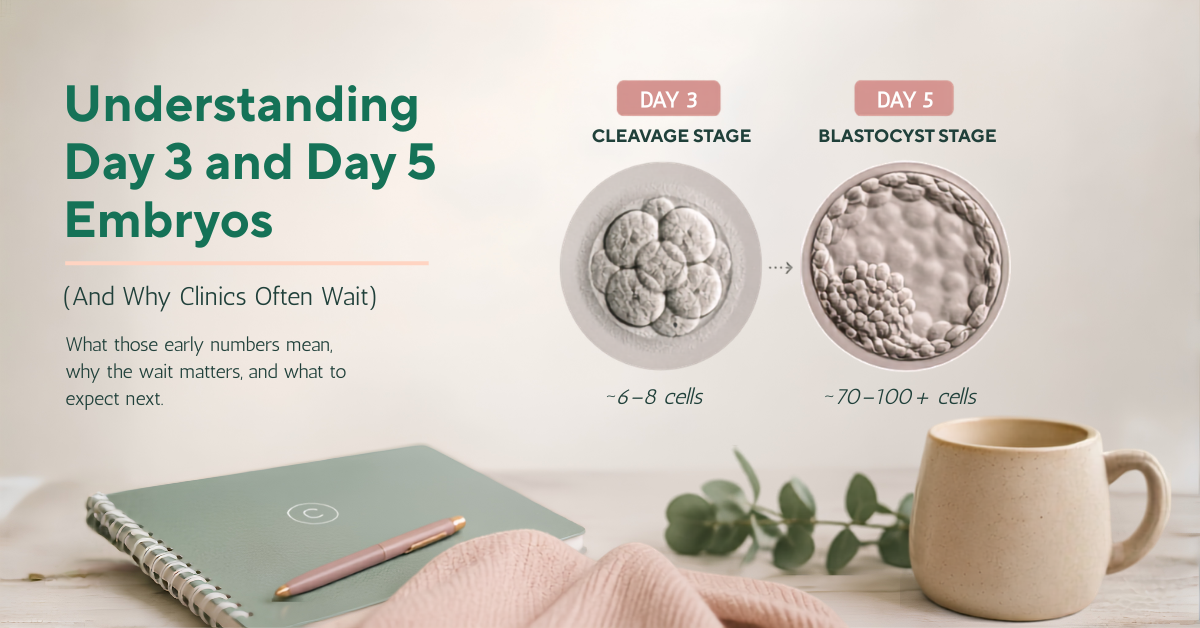
By Day 3, most embryos have reached what’s called the cleavage stage. That usually means somewhere around 6 to 8 cells. At this point the embryo is dividing, but it hasn’t yet made the bigger structural change that comes later.
A Day 3 report tells you two useful things: how many embryos are still developing, and roughly how many cells each one has reached. A healthy cleavage-stage embryo at Day 3 is generally in that 6 to 8 cell range, though clinics vary slightly in how they grade them.
What a Day 3 number can’t tell you yet is which of those embryos will keep going. That’s the part that only time answers.
What changes by Day 5
Between Day 3 and Day 5, the embryo does something more dramatic than simply adding cells. It reorganises.
By Day 5, an embryo that keeps developing becomes a blastocyst. Instead of a small cluster of 6 to 8 cells, a blastocyst holds roughly 70 to 100 cells, now arranged into two distinct parts: an inner group of cells that can become the baby, and an outer layer that can become the placenta.
This is a much bigger leap than the two days between them suggests. Not every embryo makes it, and not every embryo that does gets there on exactly Day 5. Some reach the blastocyst stage a little later, on Day 6, which is why you’ll often see clinics refer to a Day 5 or Day 6 transfer. A blastocyst that forms on Day 6 rather than Day 5 is still a normal result. Roughly a third of embryos reach the blastocyst stage overall, though this varies a lot between individuals and depends on age, egg and sperm quality, and lab conditions.
That drop-off can feel alarming when you first hear it. It helps to know it’s expected. The embryos that don’t progress are usually ones that were unlikely to lead to a pregnancy anyway.
The hidden problem: waiting without information
Here’s the part clinics don’t always prepare you for. The hardest thing about the Day 3 to Day 5 window often isn’t the science. It’s the silence.
You get a Day 3 update. Then, at many clinics, nothing until Day 5. In between, your embryos are being watched closely in the lab, but you aren’t watching anything. You’re carrying the same anxiety with no new data to settle it.
That mismatch, between how much is happening clinically and how little you can do personally, is one of the most under-acknowledged parts of an IVF cycle. It isn’t a sign anything is wrong. It’s just the shape of this stage.
Why clinics often wait until Day 5
Extending embryos to Day 5 isn’t a delay for its own sake. It’s a selection tool.
When embryos are grown to the blastocyst stage, the lab gets to see which ones keep developing on their own. An embryo that reaches a good-quality blastocyst has already passed a meaningful test that a Day 3 embryo hasn’t yet faced. That extra information helps the clinical team choose the embryo most likely to implant.
The most recent Cochrane review, updated in January 2026, found that for women with a good prognosis, a Day 5 blastocyst transfer may slightly improve the chance of a live birth per IVF cycle compared with a Day 3 transfer. This is why blastocyst transfer has increasingly become the default at many clinics.
The same review is careful about what it doesn’t yet know. It notes it’s still uncertain whether extra days in the lab give a real biological advantage, or whether they mainly act as a filter that selects the stronger embryos. And a good prognosis, in this context, usually means having several embryos to work with.
So it isn’t a universal rule, and your clinic isn’t being inconsistent if they choose differently.
When Day 3 is the right call
Growing embryos to Day 5 carries a trade-off. Some embryos that might have continued developing inside the uterus don’t survive the extra days in the lab. For patients with only a few embryos, waiting to Day 5 can mean ending up with fewer, or none, to transfer or freeze.
Because of that, the evidence isn’t fully settled, and it isn’t the same answer for everyone. A 2026 study in Human Reproduction, using data from more than 11,000 patients across Australia and New Zealand, found that among patients with only a single embryo, a Day 3 transfer was linked to a higher live birth rate than waiting for Day 5. For those patients, the uterus may simply be a better environment than the lab.
If your clinic recommends a Day 3 transfer, it doesn’t mean your embryos are weaker. It often means your team is protecting the embryos you have rather than risking them on extra days in culture. This is a genuine clinical judgement, not a downgrade.
What actually helps during the wait
A few things made this stretch more manageable, both as a doctor watching it and as a patient living it.
Ask your clinic directly what their default is, Day 3 or Day 5, and why it applies to you. The reasoning is usually specific to your embryo numbers and history.
Write down your Day 3 numbers and what you were told to expect next. In the fog of a cycle, the details blur faster than you’d think.
Know the Day 5 drop-off before it happens. If you’re expecting that not every embryo continues, a lower Day 5 number lands as information rather than a shock.
And let the silence be silence. There’s genuinely nothing you can do to change what’s happening in the lab. That’s not helplessness. It’s just this particular stage doing its work without you.
Where CycleGuide fits
Keeping track of what your clinic told you, and when the next update is due, is exactly the kind of thing that slips during an emotionally heavy week. CycleGuide is what I built to hold those details for you, so your Day 3 numbers, your next milestone, and your instructions sit in one place instead of in your memory.
You’re not doing this wrong
If the gap between Day 3 and Day 5 feels harder than the science seems to justify, that’s normal. You’re waiting on something you can’t influence, holding real hope, with no new information to steady you.
Your embryos are being watched carefully. Your clinic is making a considered decision about timing. And the quiet in between isn’t a bad sign. It’s just the wait doing what the wait does.
Keep every clinic update in one place
CycleGuide helps you hold your treatment details, milestones, and instructions through every stage of your cycle.
Available on iOS in the Australian App Store
References
Glujovsky D, Cornelisse S, Blake D, Quinteiro Retamar AM, Alvarez Sedo CR, Ciapponi A. Blastocyst-stage versus cleavage-stage embryo transfer in assisted reproductive technology. Cochrane Database of Systematic Reviews 2026, Issue 1. Art. No.: CD002118. DOI: 10.1002/14651858.CD002118.pub7
Fitzgerald O, Li W, Vallence C, Chambers GM, Rombauts L. Cleavage stage versus blastocyst stage transfers in patients with a single zygote: an emulated target trial. Human Reproduction, 2026. DOI: 10.1093/humrep/deag075