An ovulation tracker app and an IVF treatment organiser do different jobs.
One estimates information about a menstrual cycle. The other records information from a clinic-directed treatment plan.
During IVF, I needed the second type of tool.
I was no longer trying to predict when I might ovulate. I was trying to keep track of medications, injection times, appointments, procedures and changing instructions from my clinic. That practical shift is part of what a first IVF cycle actually looks like.
That distinction matters.
The best app is not necessarily the one with the most features. It is the one designed for the job you need it to do.
What does an ovulation tracker app do?
Many menstrual tracking apps ask users to enter period dates. Their algorithms then estimate the next period, ovulation date and fertile window. Some also use information such as temperature or cervical fluid.
A 2024 study in the Australian and New Zealand Journal of Obstetrics and Gynaecology described these common functions. It also noted that app estimates of ovulation timing have not been sufficiently evaluated and that existing evaluations have raised accuracy concerns.1
This does not mean every ovulation tracker app is inaccurate. Apps use different data and methods. It means a predicted fertile window should be understood as a prediction, not clinical confirmation of ovulation.
If your cycles are irregular, you have concerns about ovulation or you need medical advice, speak with your doctor.
Why IVF changes what you need from an app
An ovarian stimulation cycle is managed differently from a natural cycle.
The updated European Society of Human Reproduction and Embryology guideline covers the use of medication, monitoring, prevention of a premature luteinising hormone surge, triggering final oocyte maturation and luteal-phase support during IVF or ICSI.2
The exact protocol differs between patients and cycles. Your clinic decides what applies to you.
If your clinic has prescribed Orgalutran, our separate guide explains what patients should know about Orgalutran in IVF.
The question changes
“When might I ovulate?”
becomes
“What has my clinic asked me to do today?”
Depending on the protocol, that may include medication, an injection, monitoring or a procedure at a particular time.2
A standard ovulation tracker app may not be designed to organise that information. That does not make it a poor app. It makes it a tool for a different task.
The real tracking task during IVF
When I was going through IVF, the medicine was not the only difficult part.
The difficulty was managing everything once I was back at home. I have written separately about the gap between the clinic and home during IVF, because that is where much of the organisation fell back onto me as the patient.
Which medication was due? What time was the injection? Had the dose changed? When was the next scan? Where had I written the nurse’s instructions?
I am a medical doctor, and I still found myself checking and rechecking. Being medically trained did not remove the practical difficulty of becoming the patient, as I explain in Why Being a Doctor Didn’t Prepare Me for IVF as a Patient.
These paragraphs describe my experience. They should not be read as evidence that every IVF patient has the same difficulty.
What recent research says about digital IVF support
Research on digital support during assisted reproduction is developing, but it is still limited.
A 2023 evaluation of myFertiCare reported increased treatment knowledge and improved patient-centredness among people using that particular online tool.3 A 2025 prospective observational study of WiStim reported positive satisfaction and usability findings for a connected app used during ovarian stimulation.4
These studies are relevant because they show how digital tools have been evaluated in fertility care. However, they studied specific products, populations and settings.
Important evidence limitation
These studies did not evaluate CycleGuide. They do not prove that every fertility app improves knowledge, reduces distress, prevents medication errors or changes clinical outcomes.
Practical features to consider during IVF
These are practical considerations, not clinical requirements. Your clinic’s instructions remain the authority for your treatment.
1. A clear view of today
Consider whether the app lets you see the medications, appointments and tasks you entered for the current day without searching through several screens.
The purpose is simple: to make your own entered information easier to find.
2. Medication times and multiple daily doses
IVF protocols can include several medicines and treatment phases.2
Check whether the app lets you enter the dose and time exactly as supplied by your clinic. If you take a medicine more than once a day, check whether each dose can be recorded separately.
Reminders may be useful, but they do not verify that an instruction is correct. Always compare your entries with your current clinic plan.
Our article on common IVF medication mistakes and why they happen discusses practical sources of confusion.
One-off medication should also be easy to identify. The trigger for final oocyte maturation is a defined part of ovarian stimulation protocols.2 Always use the exact medication and timing supplied by your clinic.
You can read more in The IVF Injection You Can’t Be Late For.
3. Easy changes when the plan changes
Ovarian stimulation involves monitoring, and treatment decisions can depend on the patient’s response.2
If your clinic changes an instruction, check whether the app makes it easy to update your entry. Then compare the revised entry with the clinic’s latest directions.
An app should display what you entered. It should not decide how your dose or treatment should change.
4. Appointments and procedures in the same place
Depending on the treatment plan, IVF can involve monitoring, egg collection, fertilisation, embryo development and embryo transfer.2
You may find it useful to keep relevant appointments and procedures beside your medication entries. This is an organisation choice, not a medical recommendation.
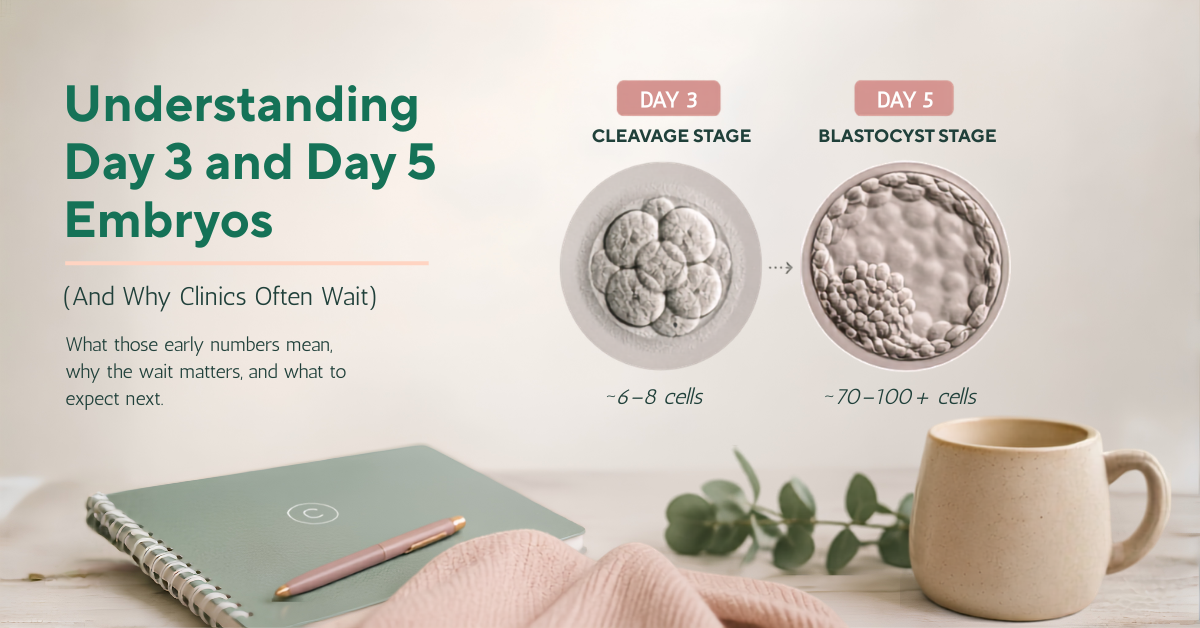
If you are approaching the laboratory stage, our guide to Day 3 and Day 5 embryos in IVF explains why embryo updates may arrive at different points.
5. Space for your clinic’s instructions
During IVF, the instructions from your own clinical team matter.
Consider whether an app lets you record notes in plain language. These might include information your clinic has provided about storage, an appointment or a question you need to clarify.
An organiser should help you store information. It should not generate personalised treatment advice.
6. A pre-cycle checklist
Before treatment begins, you may have practical tasks supplied by your clinic. These could include collecting prescribed medication, confirming an appointment or preparing questions.
A checklist can help you record those tasks. It does not determine what preparation you medically require.
7. Clear privacy information
Reproductive health apps may collect identifiable and sensitive information.
A 2025 peer-reviewed analysis examined the privacy policies and practices of four reproductive health apps in the United States and European Union. The researchers found substantial variation and raised concerns involving IP-address tracking, third parties, advertising and marketing.5
The study did not assess every reproductive health app. It did not evaluate CycleGuide, and it was not an analysis of Australian privacy law.
Its practical lesson still applies: read the privacy policy before entering personal information. Check what data the app collects, why it collects it, how it is stored and whether it is shared with other organisations.5
Do not assume that all fertility apps handle information in the same way.
Questions to ask before downloading an app
- Am I tracking a natural cycle or preparing for a clinic-managed IVF cycle?
- Do I need a fertile-window estimate or a daily treatment organiser?
- Can I record the medication and timing exactly as my clinic supplied it?
- Can I update my entries if my clinic changes the plan?
- Can I keep appointments, procedures and notes together?
- Is the privacy policy clear and easy to find?
- Does the app state that it does not replace my clinical team?
These questions help identify which category of tool matches your current needs.
Where CycleGuide fits
I created CycleGuide because I could not find a tool organised around the practical reality I experienced during IVF treatment. The full background is in Why I Built CycleGuide.
CycleGuide is an IVF treatment organiser for iPhone. Its current functions include organising user-entered medications, multiple daily doses, appointments, procedures and notes. It also allows users to update entries when instructions change and record one-off trigger medication.
The current functions are shown on the CycleGuide Getting Started page.
Your clinic provides the treatment instructions. You enter and organise those instructions in the app.
CycleGuide does not predict ovulation, recommend treatment or replace your clinical team. It has not been evaluated in the studies cited in this article, so no clinical or psychological outcome is claimed from those studies.
The right app for the right task
If you are tracking a natural cycle, an ovulation tracker app may suit that purpose.
If you are preparing for IVF, your practical need may be different. You may be looking for somewhere to organise the treatment plan supplied and adjusted by your clinic.
That is the difference between predicting a fertile window and recording what your clinic has asked you to do.
Choose the tool that matches the task in front of you.
Learn more about CycleGuide
CycleGuide is an IVF treatment organiser for iPhone. It helps you keep the instructions supplied by your clinic in one place.
This article provides general information only. It does not provide personalised medical advice. Always follow the instructions supplied by your treating clinic and contact them if anything is unclear or changes.
About the author: Dr Caroline Fiddler, MBBS, is a medical doctor, IVF patient, mother and founder of CycleGuide, an IVF treatment organiser for iPhone.
References
- Hohmann-Marriott B, Williams T, Girling J. Fertility and infertility uses of menstrual apps from the perspectives of healthcare providers and patients. Australian and New Zealand Journal of Obstetrics and Gynaecology. 2024;64(3):252-257. doi:10.1111/ajo.13781
- ESHRE Guideline Group on Ovarian Stimulation. ESHRE guideline: ovarian stimulation for IVF/ICSI: an update in 2025. Human Reproduction. 2026;41(4):498-514. doi:10.1093/humrep/deag018
- Sparidaens EM, Logger JGM, Nelen WLDM, Braat DDM, Fleischer K, Hermens RPM. Web-based guidance for assisted reproductive technology with an online app (myFertiCare): quantitative evaluation with the HOT-fit framework. Journal of Medical Internet Research. 2023;25:e38535. doi:10.2196/38535
- Plouvier P, Marcilly R, Robin G, et al. Evaluation of satisfaction with a secure, connected mobile app for women in assisted reproductive technology programs: prospective observational study. JMIR Human Factors. 2025;12:e63570. doi:10.2196/63570
- Zadushlivy N, Biviji R, Williams KS. Exploration of reproductive health apps’ data privacy policies and the risks posed to users: qualitative content analysis. Journal of Medical Internet Research. 2025;27:e51517. doi:10.2196/51517
Evidence date: References checked 3 September 2026. All cited publications were published between 2023 and 2026.